Daylight Saving Time Is Ending: 3 Easy Ways to Adjust Your Baby's Sleep Schedule

It's that time of year again! The clocks are changing, and parents everywhere are wondering the same thing…
“Does this mean my baby is going to start waking up at 5 a.m.?”
We get it. You've worked hard to establish a sleep routine that works for your family, and the thought of an earlier morning wake-up isn't exactly exciting.
But here's the good news: Adjusting your baby's sleep schedule for daylight saving time doesn't have to be complicated.
In fact, you have three simple options. Depending on your child's age and temperament, we might tell you to do nothing at all!
Option 1: The Gradual Approach — Start Tuesday
Best for: Babies who thrive on consistency, children with sensitive sleep schedules, or families who want to prepare ahead of time.
Starting Tuesday, October 27, begin pushing your baby's entire schedule 10 minutes later each day.
That includes morning wake-up, naps, feedings, and bedtime. So if your little one typically wakes at 7 a.m. Leave him/her in the crib until 7:10 a.m. Start the first wake window when they come out of the crib.
This will help push down their entire day gradually.
Here's an example if your baby normally goes to bed at 7:00 p.m.:
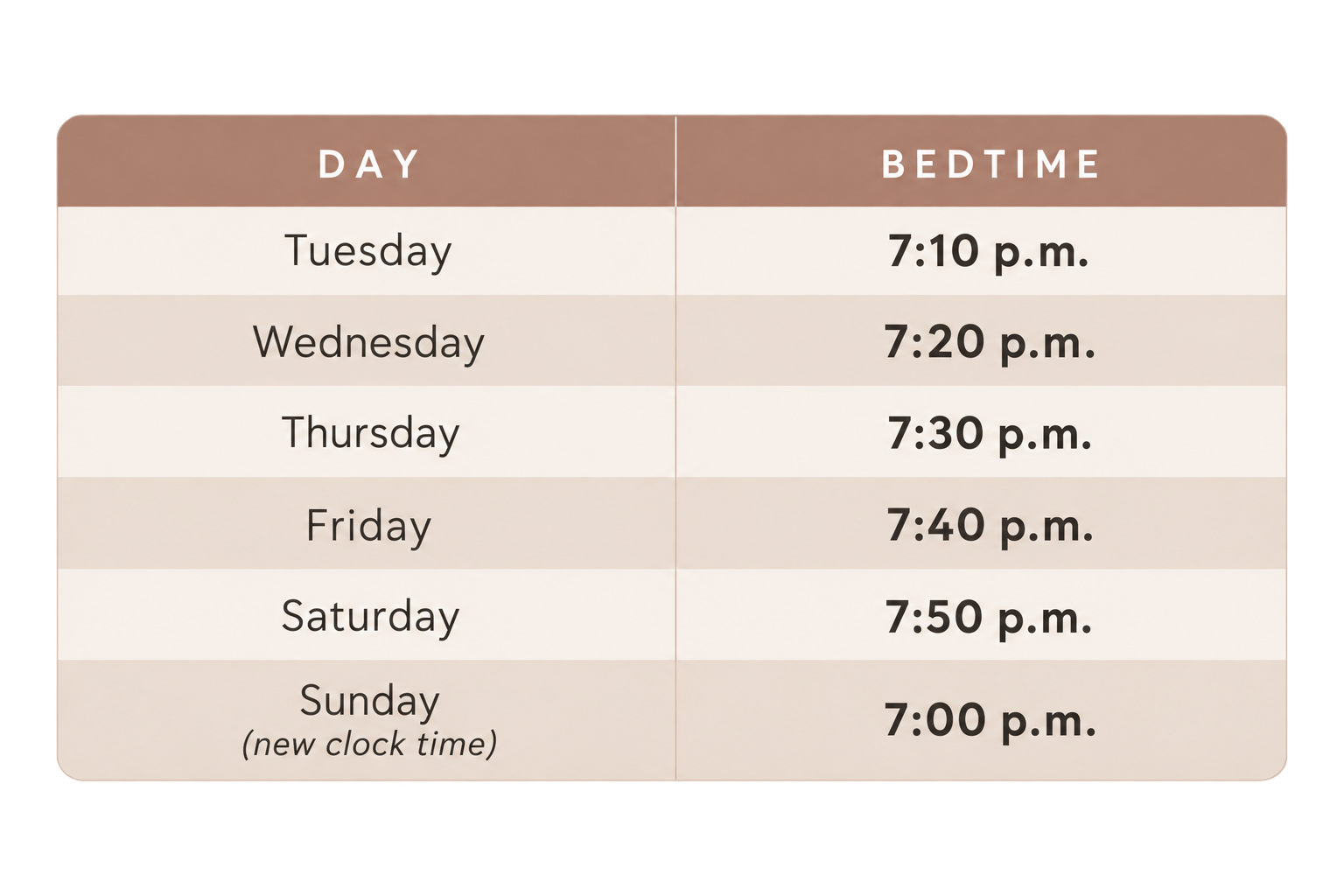
By Sunday, your baby's schedule will be close to their usual clock times, without needing to make a big adjustment overnight.
Our tip: Don't worry about getting every single minute perfect. Watch your baby's sleepy cues, and avoid pushing them so far that they become overtired.
Option 2: The Weekend Approach — Start Saturday
Best for: Families who don't want to spend the entire week adjusting their schedule.
If Tuesday comes and goes and you haven't changed a thing, don't panic!
Starting Saturday, October 31, push your child's schedule 15 minutes later.
When the clocks change Sunday morning, continue moving the schedule toward your usual clock times in 15-minute increments over the next few days.
For example, if bedtime is normally 7:00 p.m.:
Saturday: 7:15 p.m. (before the clock change)
Sunday: 6:30 p.m. (new clock time)
Monday: 6:45 p.m.
Tuesday: 7:00 p.m.
This approach gives your little one a few days to adjust without needing a full week of preparation.
And remember, if your baby is showing clear signs of tiredness, it's okay to be flexible. An overtired baby isn't going to adjust any better simply because we're determined to follow the clock!
Option 3: Do Absolutely Nothing!
Best for: Newborns, many toddlers aged two and older, and families who prefer to keep things simple.
Yes, you read that correctly.
You can do nothing.
Newborns are still developing their sleep-wake rhythms, and their schedules are often naturally flexible.
Older toddlers may also handle the time change without much preparation, especially if their routines are already well established.
For many families, the simplest option is to continue with their normal routine and let their child's body gradually adjust over the following week.
If your toddler usually wakes at 6:00 a.m., they may wake closer to 5:00 a.m. on the first morning after the clocks change.
That doesn't mean you have to start your day at 5:00!
We recommend keeping the room dark and maintaining a quiet, restful environment until at least 6:00 a.m., when appropriate for your child's age and needs.
For babies, continue responding to feeding and comfort needs. You can keep things dark and calm without expecting them to stay asleep or wait for a feed.
As the days go by, you can gradually shift meals, naps, outdoor time, and bedtime back toward your preferred clock schedule.
Our favourite reminder? You don't need to fix something that isn't a problem. If your child handles the time change beautifully, carry on!
A Few Extra Tips for a Smoother Transition
Regardless of which method you choose, a few simple things can make the adjustment easier:
1. Keep mornings dark when needed. If your child wakes earlier than you'd like, avoid turning on bright lights or immediately starting the day's activities.
2. Use daylight to your advantage. Natural light during the day helps support your child's developing body clock.
3. Keep your bedtime routine consistent. The familiar sequence of feeding, bath, books, cuddles, or whatever your family normally does can help signal that bedtime is approaching.
4. Watch your baby, not just the clock. Sleepy cues still matter! If your baby is clearly exhausted, don't force an extra 15 minutes of awake time just to follow a schedule.
5. Give everyone a little grace. Some children adjust quickly, while others need several days or longer. Both are normal.
Our Final Advice? Don't Overthink It.
We know how easy it is to worry about every nap, wake window, and bedtime adjustment.
But daylight saving time doesn't need to become another source of stress.
Choose the approach that works best for your family, stay flexible, and remember that a few slightly unusual sleep days don't mean all your progress has disappeared.
And if your baby's sleep was already a struggle before the clocks changed?
That's where we can help.
At Sleepy Ever After, we specialize in figuring out why babies and toddlers are struggling with sleep, rather than simply handing parents another generic schedule.
During our 45-minute Sleep Strategy Call, we'll look at your child's unique sleep patterns, discuss what's happening, and help you create a realistic plan for moving forward.
Ready to get some answers?
With love,
Karina + Becky
Sleepy Ever After — We know sleep. You know your baby. 🤍
